

A strong core, taught through STEAM.
Albert Einstein Academy pairs rigorous reading and mathematics with integrated STEAM, two world languages, and project-based learning in every grade from kindergarten through grade 9.
Academic Model
Four pillars, one connected program.
Subjects are taught with connections rather than in isolation, so skills learned in reading and math are applied in science, design, and service.

S
STEAM Integration
A weekly design lab in every grade ties science, technology, engineering, arts, and mathematics to real problems students can build and test.
W
World Languages
Spanish from kindergarten and Mandarin Chinese from grade 6 build communication skills and cultural understanding.
C
Community Service
Every grade completes a service-learning project, connecting classroom skills to the needs of the community.
G
Global Citizenship
Global studies invite students to consider cultures, communities, and shared challenges with curiosity and respect.
Subjects & Courses
What students study.
A consistent core runs through every grade, growing in depth from early foundations to middle-grade coursework that prepares students for high school.
English Language Arts
A structured literacy program in K–2 builds phonics and fluency; grades 3–9 move into close reading, evidence-based writing, and literature study.
Mathematics
A coherent K–9 sequence from number sense to pre-algebra and Algebra I, emphasizing reasoning, fluency, and real-world problem solving.
Science
Hands-on, NGSS-aligned units in life, earth, and physical science, with lab investigations and the weekly STEAM design challenge.
Social Studies
Arizona and U.S. history, world geography, civics, and global studies that connect to the school's citizenship pillar.
Arts & Design
Visual art, music, and design woven into STEAM, giving students another language for ideas and expression.
Physical Education & Wellness
Daily movement, health, and social-emotional learning that support focus, friendship, and well-being.
World Languages
Two languages, real cultural learning.
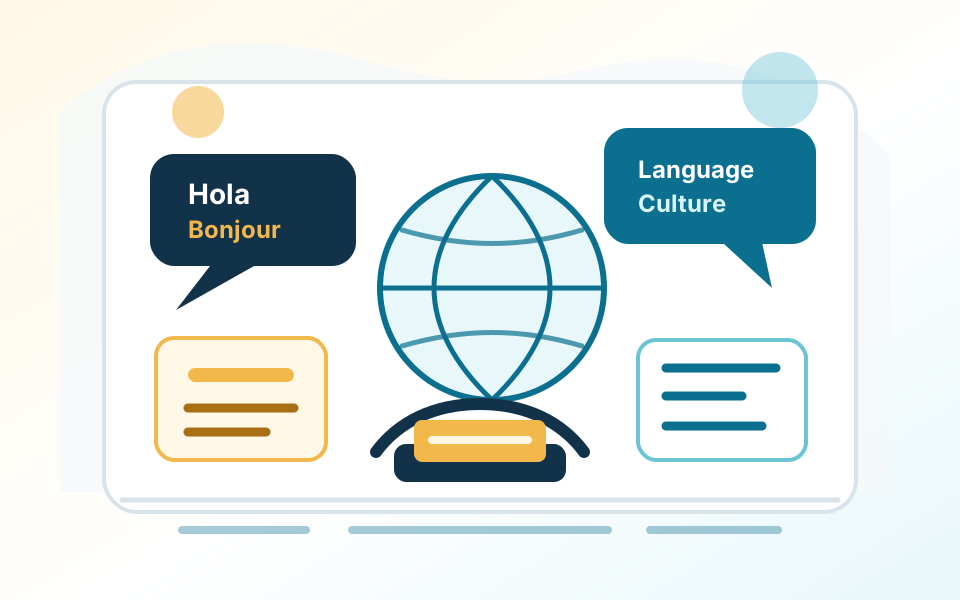
Language is central to AEA's global focus. Every student studies Spanish, and middle-grade students add Mandarin Chinese, taught by dedicated language faculty.
In the elementary grades, Spanish is taught several times a week through songs, stories, and conversation, with cultural units tied to the social studies curriculum. Beginning in grade 6, students take Mandarin Chinese and continue Spanish, building toward conversational proficiency and an appreciation of the cultures behind each language.
Language pathway
- Grades K–5Spanish, multiple sessions each week
- Grades 6–9Mandarin Chinese, plus continued Spanish
- Taught bySra. Lucía Fernández & Ms. Wei Chen
- FocusConversation, culture, and global awareness
Daily Schedule
A typical school day.
Mornings focus on literacy and math; afternoons bring science, language, the arts, and the STEAM lab. Wednesdays release early at 1:30 p.m. for teacher planning.
| Time | Elementary (K–5) | Middle (6–9) |
|---|---|---|
| 7:50 | Arrival & morning meeting | Arrival & advisory |
| 8:00–9:30 | Literacy block | Mathematics |
| 9:30–10:45 | Mathematics | Science |
| 10:45–11:15 | Recess & snack | Elective |
| 11:15–12:00 | Science / social studies | World language |
| 12:00–12:45 | Lunch & recess | Lunch |
| 12:45–1:45 | World language | Humanities |
| 1:45–2:45 | Specials / STEAM lab | STEAM lab |
| 2:45–3:15 | Reflection & dismissal | Reflection |
| 3:30 | — | Dismissal |

Assessment & Results
Above the state average in every tested subject.
AEA participates in Arizona's statewide assessment (AzM2). Our 2024–25 results placed students well above the state average in English language arts, mathematics, and science.
Teachers also use short cycle assessments three times a year to track growth and adjust instruction. Families receive a progress report each quarter and meet with teachers at fall and spring conferences.
| Subject | AEA proficient | Arizona average |
|---|---|---|
| English language arts | 74% | 47% |
| Mathematics | 79% | 41% |
| Science | 71% | 45% |
| Daily attendance | 95% | — |
Supporting Every Learner
Challenge and support, side by side.
AEA uses a multi-tiered system of supports (MTSS) so students who need extra challenge and students who need extra help both move forward.
Our special education team provides services under each student's IEP or 504 plan, and our reading and math interventionists work with small groups during the school day. Students ready to go deeper take on extension projects and advanced math placement in the middle grades. The school counselor, Angela Brooks, supports social-emotional learning across all grades.
How we support students
- InterventionDaily small-group reading and math support
- Special educationIEP and 504 services with a dedicated team
- EnrichmentExtension projects and advanced math placement
- CounselingSocial-emotional learning in every grade
Next Step
See our program in action.
Schedule a tour to visit classrooms, meet teachers, and ask about grade availability for your child.
Curriculum questions?
Email [email protected] or call (662) 778-8559 to speak with our academic team about courses, placement, and support.